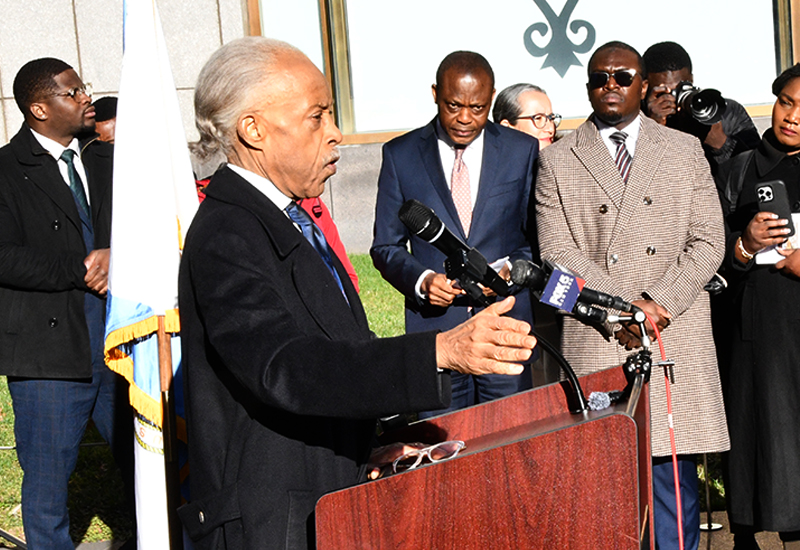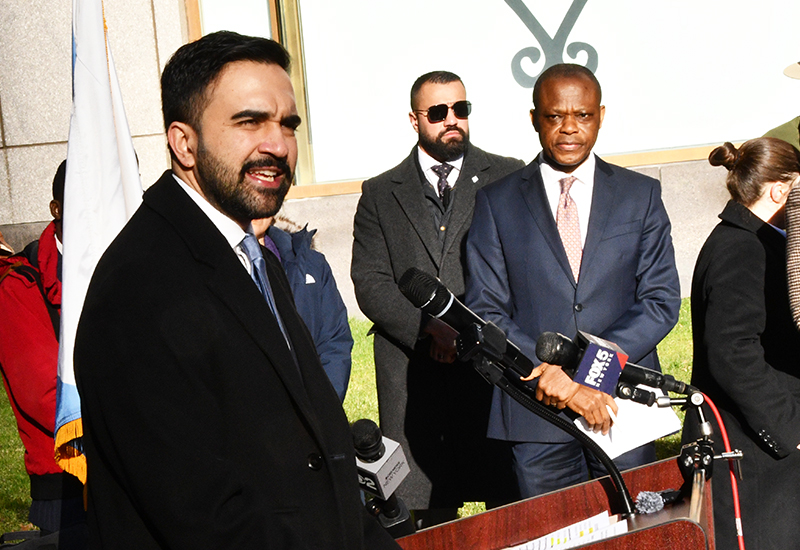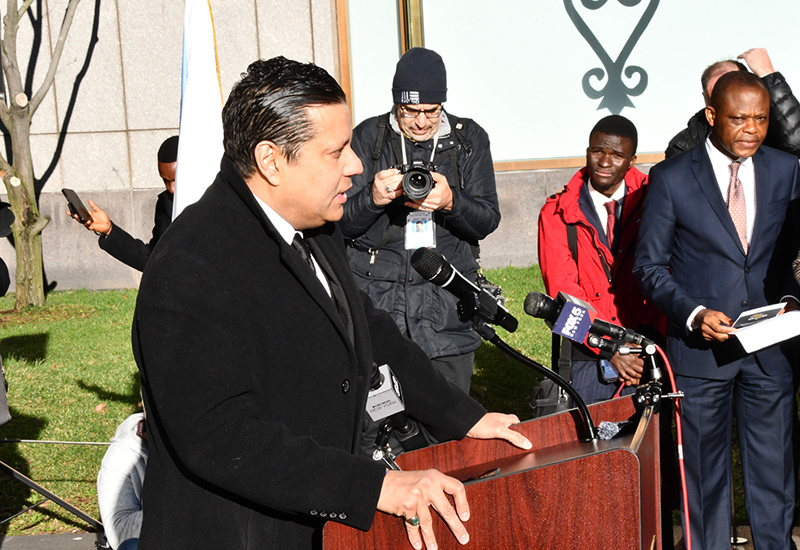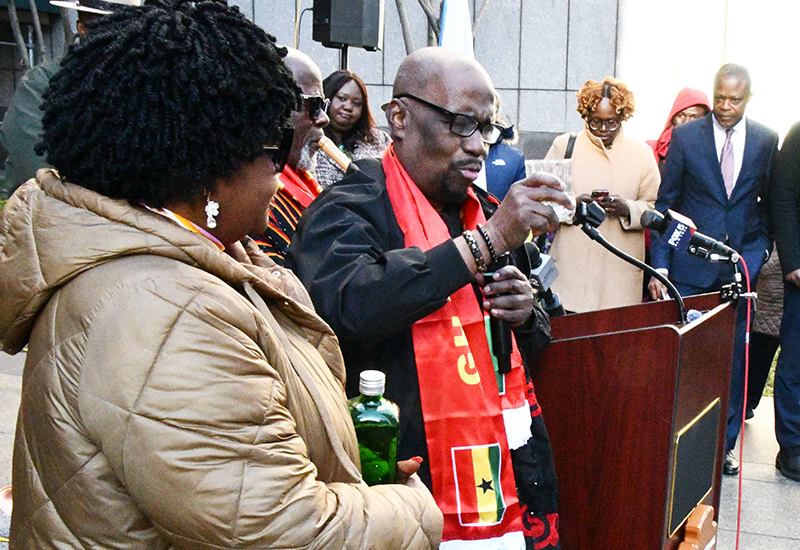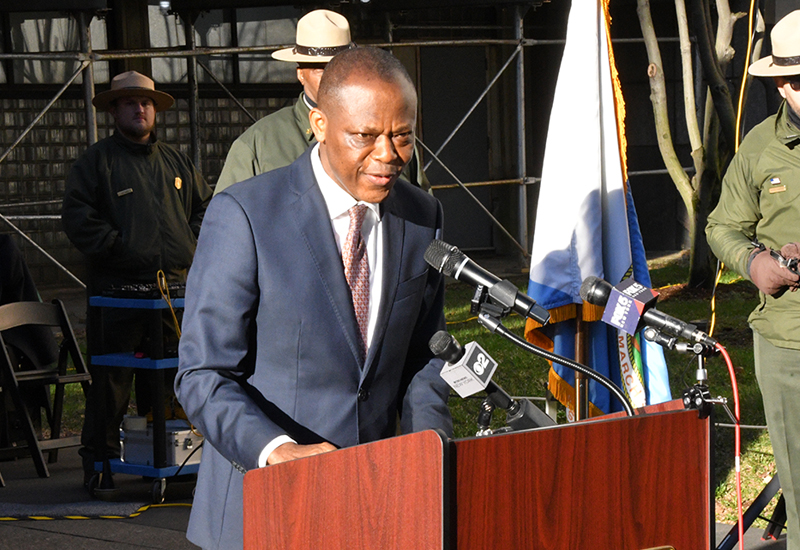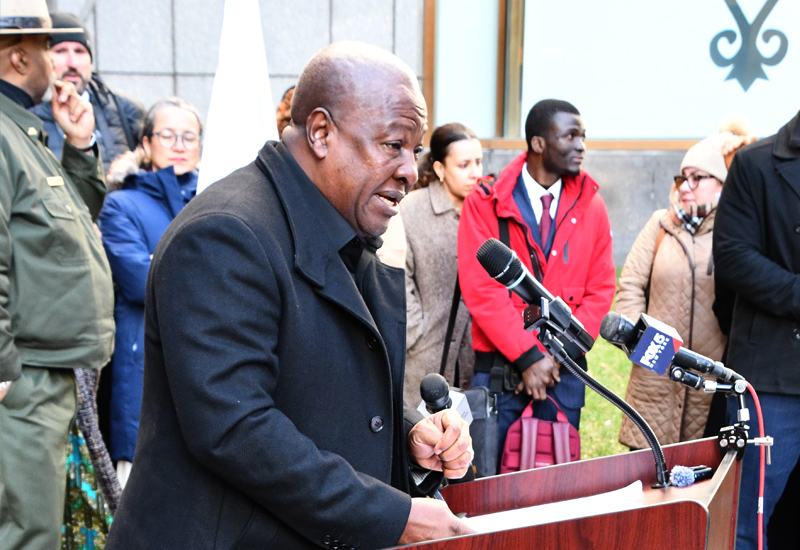
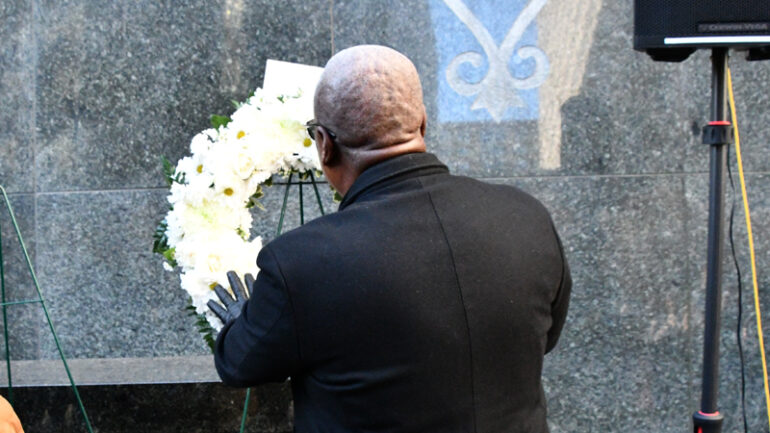
President Mahama leads a wreath-laying ceremony at the African Burial Ground

Good morning.
Amongst people of African descent throughout the Diaspora, as well as indigenous Africans on the continent, the collective rituals surrounding death are a communal experience, from its announcement to its recognition through ceremony.
If you travel to Africa, from the top of the continent to the bottom, in most cities, towns, and villages, you will see notices of people’s deaths—not small obituaries in newspapers, but flyers, posters and billboards—plastered all around.
Listed on them is usually a litany of names of the bereaved. Not just immediate relatives, but also names of extended family members, whether they are local or living abroad, and tribal or community leaders.
All the people to whom the deceased belonged. And the funeral services are often attended by people who were not personally acquainted with the deceased.
That’s because we do not mourn as individuals.
We mourn as families.
We mourn as communities.
We sometimes mourn as nations.
In this case, we are mourning as an entire community today.
As the African Union Champion on Reparations, I am here today on behalf of the 1.4 billion citizens of the African continent.
We lay down this wreath to honour the memories of the nearly 20,000 Africans who are buried on these grounds, some of whom were free but most of whom were enslaved.
I cannot speak of the events that transpired here in New York without also mentioning the events that occurred on the continent, especially in my homeland, Ghana.
Those events are not separate stories, as we have been led to believe; they are parts of one single narrative, sometimes even happening concurrently.
And it is a narrative that was, quite literally, branded, carved, burned, and beaten into the bones of people, human beings, including our ancestors who are buried here.
Ghana has more than thirty slave castles and forts, more than any other African country.
As such, there is a high probability that many of the African men, women, and children who were enslaved came through, if not from, the land that is now known as Ghana.
One of those forts, Kormantine, was built by the British in 1631.
Enslaved Africans were transported from there to the British colonies in the Caribbean and America. Those individuals were referred to as Coromantees.
In 1665, Fort Kormantine was seized by the Dutch in retaliation because the British had taken many of its territories and holdings—such as the Dutch colony of New Amsterdam, which, just a year earlier in 1664, had been captured by the British and renamed New York.
This burial ground is believed to have been in use as early as the mid-1600s, but the first written record of its existence dates to 1712. That year, there was an uprising in New York led by the Coromantees, who gained a reputation across the so-called New World for being rebellious.
This is because the Coromantees led revolts wherever they were taken: South Carolina, Jamaica, St. John, Antigua, Barbados, and Guyana.
As a result of this particular revolt in New York, nine white people were killed; seven were injured.
Seventy enslaved Africans were arrested. Twenty-one were executed; some were hanged, others were burned alive; a few were deprived of food and water and forced to starve.
Those enslaved Africans, those human beings—our ancestors—were killed and buried right here, on these grounds.
This type of brutality was common. It is written in the bones of those who were laid to rest here.
After this burial ground was discovered in 1991, archaeologists exhumed and studied the skeletal remains of 419 individuals. Several of those bodies belonged to children under the age of four.
Their bones told the story of harsh labour and malnutrition. An infant, only two months old, was laid to rest with a string of yellow beads around its neck, one for each week of its brief life.
Many individuals were buried with beads, of all colours—beads adorned their waist or wrist, or one lone bead tucked in the palm of a closed fist. They were sometimes also buried with coins, in their hands, or on the closed lids of their eyes.
They were wrapped in white cotton or linen shrouds that were fastened, like a cape, with a brass straight pin. They were buried with their heads to the West, so that their bare feet pointed towards Africa, primed for the return home, if only symbolically.
It is both heartening and heartbreaking to contemplate the care, attention to detail, and sheer love with which they were laid in their final resting place.
They were buried this way so that through death, they might finally, in the ancestral realm, receive all that they had been deprived of in the physical realm.
We lay this wreath today in honour of those buried here who resisted domination and disrespect. And also, in recognition of their valiant pursuit of freedom.
What could possibly prepare any human being for the indignity of being stripped of their basic humanity? Of being bought, kept, and sold as property?
A half mile away from here, on the shore of the East River, at Wall Street, which is considered the financial capital of the world, is where the slave market was situated.
That distance, from the auction block to the burial ground, from the start of their new lives in America to the end of their natural lives in this world, may have been brief in miles and even in years, but it was long in suffering, misery, and pain.
African people could not be buried in church cemeteries. They could not be buried in private cemeteries where white people were buried; they could not even be buried in the pauper’s cemetery that was meant for the homeless, indigent, or incurably ill.
They could not bury their dead in the evenings. And when there was a burial, only a dozen or fewer people were allowed to attend, so the deceased were even deprived of the public ceremony that was a customary rite in so many of their homelands.
But we are here today, as we were in 2003, when the remains of those who had been exhumed were reinterred.
The coffins of those 419 individuals were handcrafted in Ghana. Carved into each one is an Adinkra symbol. Many of those same symbols are etched into this very monument.
Adinkra is native to the Akan people of Ghana, or, as they became known after their enslavement, the Coromantee. Each of these symbols represents a proverb, a philosophical or moral truth.
The “sankɔfa” symbol represents an abbreviation of the proverb “Sɛ wo werɛ firi na wosan kɔfa a, yɛnkyiri.”
The literal translation of this is “If you have forgotten something, it is not taboo for you to go back and get it.”
The proverb’s essential meaning is, “You must take the wisdom gained from the lessons of the past and use it in building your future.”
Tomorrow, the 25th of March, is the International Day of Remembrance of the Victims of Slavery and the Transatlantic Slave Trade.
We lay down this wreath in remembrance of all the victims of slavery and the transatlantic slave trade—the men, women, and children who were taken from their lives and from those who loved them to be enslaved in a foreign land; and, also, the people to whom they belonged, the mothers, fathers, grandparents and children whose lives were forever altered after their parents, children, siblings were stolen from them and their communities.
In furtherance of this remembrance, this recognition, tomorrow, Ghana, on behalf of the African Union, CARICOM and all persons of African descent, will table a resolution before the United Nations General Assembly to formally recognise the transatlantic slave trade and slavery as the gravest crime against humanity and to affirm the principle, as well as initiate the process of reparatory justice.
We lay down this wreath as a promise to our progeny that never again will such atrocities be visited upon our people.
Never again.
Never again.
Thank you.