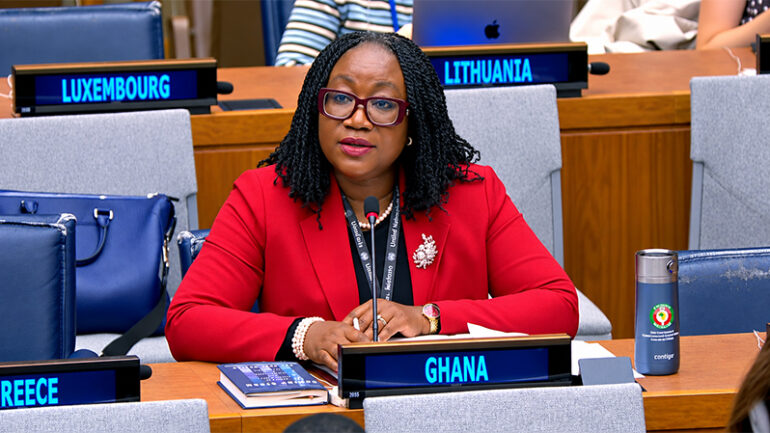
During the joint debate on the Decolonisation Agenda Items of The Fourth Committee

- Posted by admin
- Posted in Fourth Committee, News, Statement & Remarks
Mrs. Freda Bediako-Puni
Minister/Plenipotentiary
United Nations HQ, New York
13th October 2026
DURING THE JOINT DEBATE ON THE DECOLONISATION AGENDA ITEMS OF THE FOURTH COMMITTEE
Madam Chair,
My delegation congratulates you and the members of the Bureau on your election to steer the conduct of the business of the Fourth Committee during the 81st Session. Ghana assures you of her full cooperation and looks forward to working with you for a successful session. Ghana aligns itself with the statements delivered on behalf of the Non-Aligned Movement and wishes to add the following remarks in its national capacity.
Madam Chair,
Decolonization is not an abstract agenda item to Ghana. In 1957, Ghana became the first country in sub-Saharan Africa to wrestle its independence from colonial rule. Ghana’s first President declared that our 2 independence was meaningless unless it was linked to the total liberation of Africa. This principle and conviction still guide our engagement in this Committee.
From hosting the All-African People’s Conference in December 1958, to bringing together liberation movements from across the continent at a time when most of Africa was still under colonial rule, Ghana has learnt that self-determination is not granted by goodwill alone. It is achieved through the persistence demand of the inherent right of all peoples and the steady support of the international community.
This Committee has long been at the heart of that support. Sixty-six years after the adoption of the Declaration on the Granting of Independence to Colonial Countries and Peoples, contained in General Assembly resolution 1514 (XV), seventeen Non-Self-Governing Territories remain on the United Nations list. As we enter the final years of the Fourth International Decade for the Eradication of Colonialism, 2021 to 2030, we must honestly ask whether our methods match our ambition.
The Decade ends in 2030. My delegation believes the time has come for a frank, forward-looking assessment of what has worked and what has not. Too many of the resolutions we adopt each year are carried over with little change, while the situation of the peoples concerned evolves. We encourage the Special Committee to consider how its working methods, its reporting and its engagement with the Territories can be made more results-oriented in the remaining years of the Decade.
Ghana believes that progress depends on five things.
First, a case-by-case approach that places the freely expressed wishes and interests of the peoples of each Territory at the centre of the process, consistent with the Charter of the United Nations and relevant General Assembly resolutions.
Second, constructive cooperation between the Special Committee on Decolonization and the administering Powers. Visiting missions, regional seminars and direct engagement with the peoples of the Territories remain the most reliable sources of accurate information. We encourage administering Powers to facilitate such missions.
Third, attention to the economic, social and environmental realities of the Territories. Many are small island communities facing the effects of climate change, limited economic diversification and vulnerability to external shocks. Their development and their political future cannot be separated.
Fourth, the role of the wider United Nations system. The specialized agencies and other entities of the system have a valuable contribution to make in education, health, disaster preparedness and capacity-building in the Territories. Ghana encourages them to continue extending such support and calls for economic activities in the Territories to be conducted in a manner that respects the interests and welfare of their peoples.
Fifth, on the issue of information. The peoples of the Territories can only make informed choices about their future if they have full access to information on the options available to them under General Assembly resolution 1541 (XV). We commend the Department of Global Communications for its work in disseminating information on decolonization, and we stress that this function must remain adequately resourced, including as the Organization pursues reforms to strengthen its efficiency.
Madam Chair,
Education remains one of the most powerful tools for self-determination. Ghana values the offers made by Member States of study and training facilities for 4 inhabitants of the Non-Self-Governing Territories and encourages their continuation. An educated and empowered generation is the best guarantee that any decision on a Territory’s future will be informed, genuine and sustainable.
Madam Chair,
In relation to the African continent and on the question of Western Sahara, Ghana welcomes the adoption of Security Council resolution 2797 (2025) and supports the United Nations-led political process under the auspices of the SecretaryGeneral and his Personal Envoy. We encourage the parties to engage in good faith and without preconditions in furtherance of the Security Council resolution for a lasting political solution. Ghana considers the Autonomy Plan as a realistic basis for a just solution and urges that rigid positions must give way to constructive and forward-looking engagements focused on concrete outcomes. The unfinished business of decolonization also extends to the lasting consequences of colonialism and the transatlantic enslavement of Africans and the continuing legacies of its racialized injustices. Ghana will continue to advance reparatory justice, in partnership with the support of the African Union and CARICOM.
Madam Chair,
The credibility of this Committee rests on its ability to deliver results for the peoples it serves. Every Territory is different, and no single formula will fit them all. What must be common to all, however, is respect for the Charter, genuine dialogue among all concerned, and a shared determination to bring this chapter of history to a close. Ghana stands ready to work with all delegations, the administering Powers and the Special Committee towards that end.
In conclusion, Madam Chair, Ghana reaffirms its commitment to the work of this Committee and to the realization of a world free of colonialism in all its forms and manifestations. I thank you.