President of Ghana John Dramani Mahama address at the US-Ghana Presidential Roundtable

I think my remarks will set the tone and then I look forward to the interactive period and so if you have about 12 minutes I’ll inflict this statement on you and then after that we can have a more relaxed discussion. It’s a pleasure to be with you again. I thank the US Chamber of Commerce and its US Africa (Business Center for bringing us together to discuss the next phase of the economic partnership between Ghana and the United States.
It’s also good to be back at NASDAQ where we held this roundtable last year. That engagement allowed us to discuss Ghana’s investment climate, hear the concerns of American businesses and outline the reforms my government intended to pursue. At that meeting I made a specific commitment that we will reform the minimum capital requirements that have become a barrier to foreign investments.
I returned this year having honored that commitment. Parliament has passed the new Ghana Investment Promotion Authority Act 2026 which I have signed into law as Act 1173 and removes the blanket minimum capital requirements that previously applied to most foreign investors and established it establishes a more responsive framework for investment in Ghana. I begin with this example because governments and investor confidence through action.
When we identify an obstacle to investment we must remove it and when we commit you should expect us to return and account for what we’ve done. Investor interest in Ghana is also improving. Foreign direct investment recorded in 2025 reached approximately 2.6 billion dollars, about four times the level recorded in the previous year of 2024.
This is encouraging and yet the volume of investments entering Ghana tells only part of the story. Equally important is what that investment produces after it arrives. Does it build a factory? Does it expand the farm? Does it introduce new technology? Does it increase our exports and create decent jobs? These are outcomes that matter to us.
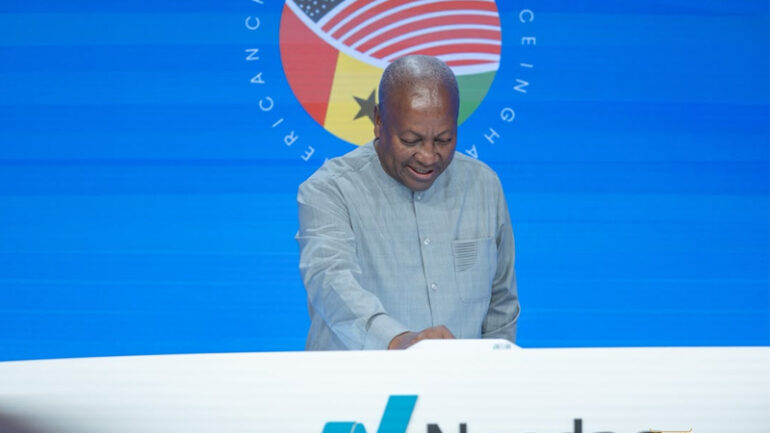
I’m also pleased to have participated in today’s NASDAQ bell ringing. NASDAQ we thank you very much. It was carried live and people were watching from Ghana and everybody’s sending me texts, oh we saw you on NASDAQ ringing the bell.
It offers another opportunity to highlight the economic relationship that exists between Ghana and the United States and the greater ambition our businesses can pursue together. Our meeting takes place as leaders from around the world gather in New York for the 81st session of the United Nations General Assembly and so this roundtable allows us to use that occasion for a focused discussion on business and investment and on the steps Ghana and the United States can take to deepen our economic relationship. Since we last met, Ghana has continued the difficult work of restoring macroeconomic stability, strengthening our public finances and rebuilding confidence in our economy.
And I’m pleased to announce that the results are encouraging. Ghana’s economy grew by 6% in 2025, while growth reached 6.4% year-on-year in the first quarter of 2026. Inflation fell sharply to 2.3% and has elevated slightly to 5%.
Of course everybody knows what’s happening in Iran. We’re praying that that conflict comes to an end early. I’m sure that the U.S. itself is feeling the pinch of that war.
These gains matter, but stability is not an end in itself. We start stability so businesses can plan with greater certainty. Investors can decide with greater (3:57) confidence and productive enterprises can grow.
The gains we have made must now begin to show in the cost of doing business. Interest rates must come down. Long-term financing must become more available.
A business that wants to expand production and employ more people must be able to finance that expansion at a reasonable cost. More capital must also flow into agriculture, manufacturing, energy, infrastructure, technology, and other productive activities. At the same time, businesses need reliable power, efficient transport and logistics, and industrial infrastructure that allows them to compete.
Ghana must produce more of the goods we currently import where we have the capacity to do so. We must also expand exports and more foreign exchange and broaden the productive base of the economy. Most importantly, we need jobs.
Our young population is growing and the economy must create opportunities at a pace that responds to that growth. To stabilize the economy, our task now is to convert that stability into production, exports, and jobs. Our 24-hour economy and our serrated export development program is central to that effort.
The 24-hour economy is not a directive requiring every business to remain open 24 hours a day. It is a framework that enables enterprises with a market and commercial basis to create additional shifts, raise outputs, and employ more people. If a factory can run a second or third shift, it should be able to do so.
If post-logistics services and other supporting activities can operate for longer hours and improve the movement of goods, we should make that possible. We’ve established a 24-hour economy authority to coordinate this program and also implementing measures to support qualifying businesses, including duty-free importation of plant and equipment and faster clearance procedures at the ports. As production expands, opportunities will also arise in transport, logistics, warehousing, cold chain facilities, digital services, and other supporting activities.
Reliable energy becomes even more important in such an economy. A manufacturer cannot run additional shifts if power is unreliable. That’s why I’m wondering how Chevron is surviving in Nigeria.
Ghana therefore welcomes American investors. Power is stable in Ghana, I can assure you. Chevron, when you come, you’ll find out.
Ghana therefore welcomes American investment and technology in power generation, transmission, and distribution, in renewable energy and industrial energy solutions. Technology is another area with considerable room for cooperation. Opportunities exist in digital infrastructure, data centers, artificial intelligence, financial technology, and other technology-enabled services.
When we met here last year, we discussed opportunities in agriculture, in agribusiness, energy, mining, health, pharmaceuticals, and technology. Those opportunities remain. Our sharper focus now is on the value Ghana retains from them.
Ghana produces cocoa, gold, manganese, and many other commodities. Our farmers grow cashew nuts, share fruits, vegetables, and grains, and yet too much still leaves our country in the raw form, while we import finished products that we could increasingly produce at home. This pattern must change if we are to create enough jobs and build stronger Ghanaian enterprises.
Agriculture provides a good example. Ghana is one of the world’s leading cocoa producers, but our interest cannot end with just exporting raw cocoa beans. Opportunities exist in cocoa processing, cashew, share, horticulture, grains, poultry, livestock, and food manufacturing.
Processing more of what our farmers produce in Ghana creates a market for farmers, work for processors, businesses for suppliers, transporters, and jobs along the value chain. For an investor, Ghana’s domestic market is only one part of the opportunity. The African continental free trade area is bringing together a continental market of more than 1.4 billion people, and this secretariat is headquartered in Accra.
And so a company that establishes production in Ghana should be thinking beyond our borders. It should look for opportunities across West Africa and the wider continent as implementation of the African continental free trade area progresses. Do not look at Ghana’s 34 million population only for what you can sell there.
Look at Ghana for what you can produce and sell across Africa and to the world. Ghana is also preparing to assume the chairmanship of the African Union, and we use that responsibility to support Africa’s work on infrastructure industrialization, regional integration, and implementation of the African continental free trade area. Regional integration will also require roads, ports, reliable energy, digital connections, and efficient borders.
These are all areas in which American businesses have a comparative advantage. We therefore see Ghana’s 2027 responsibility as an opportunity to advance an African economic agenda in which governments create the condition for growth. And so a new chapter in Ghana-United States economic relations.
Ghana and US have built a strong partnership. Trades in goods and services between our two countries reached approximately 4.6 billion dollars in 2025, and Ghana has benefited from the African Growth and Opportunities Act for more than two decades. We value this relationship, including the development cooperation that has supported Ghana over the years.
The next chapter of this relationship must play greater emphasis on trade and investment, technology, and productive enterprise. American capital, American technology and experience can work with Ghanaian businesses and skills to produce goods and services for Ghana, Africa, and the world market. And so we’d like to see more American companies producing in Ghana, buying from Ghanaian suppliers, and sharing technology and knowledge with us.
Ghana offers political stability, astrategic location in West Africa, and cultural and mineral resources, improving macroeconomic conditions, and access to the wider African market. American companies bring technology, long experience, and in building and managing major businesses. By bringing our strengths together, we can build a partnership that is both commercially rewarding and developmentally meaningful.
Source: Government of Ghana