
59th session of the Commission on Population and Development, CPD59
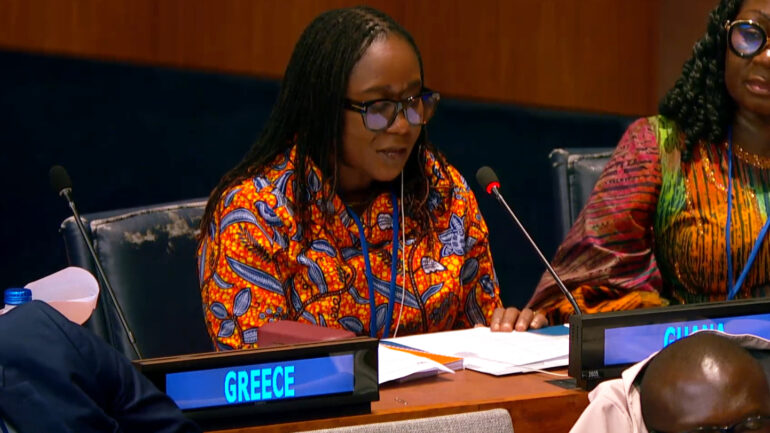

- Posted by admin
- Posted in News, Statement & Remarks
Ms. Angelina Osei Kodua-Nyanor
Executive Director, National Population Council
Conference Room 4, UNHQ
April 13th, 2026, New York
Excellencies, Distinguished Delegates,
Ghana is honoured to contribute to this year’s dialogue on Population, Technology and Research in the Context of Sustainable Development. We underscore that demographic change and digital transformation are mutually reinforcing drivers of inclusive growth, resilience, and human development.
Ghana’s population is projected at 34.4 million in 2026, growing at an annual rate of 2.1 percent. Our population remains predominantly youthful, with 12.6 million people between the ages of 15 and 35, even as the proportion of older persons continues to rise, now at 6.5 percent. Harnessing the demographic dividend, while ensuring dignity and wellbeing across the life course, remains central to our national development agenda.
Since the adoption of the ICPD Programme of Action, Ghana has made sustained investments in strengthening its population data ecosystem. Under the leadership of the Ghana Statistical Service, we have modernised data production through digital census operations and advanced analytics. Integrated administrative systems, including the national identification platform, are enhancing interoperability and improving the accuracy and timeliness of population statistics.
Innovative data sources are also informing real-time decision-making. From mobile phone data supporting mobility analysis to citizen-generated data platforms, we are gaining deeper insights into gender-based violence, sanitation, and service delivery. Digital dissemination tools such as StatsBank are expanding access to data and strengthening evidence-based planning, monitoring, and evaluation across sectors.
Ghana continues to prioritise sexual and reproductive health and rights as a foundation for sustainable development. We have expanded access to antenatal care, skilled delivery, family planning, and HPV vaccination. The integration of family planning into the National Health Insurance Scheme, alongside new health financing initiatives, is improving sustainability and access. To address persistent adolescent reproductive health challenges, we are leveraging digital health solutions—including telemedicine, SMS platforms, and social media outreach—guided by the Ghana Health Service Digital Health Strategy.
As our population ages, Ghana is advancing age-responsive policies. The National Ageing Policy, together with social protection programmes such as LEAP, provides income support and health insurance to vulnerable older persons through biometric digital payment systems. Partnerships with academic institutions continue to promote research, advocacy, and social inclusion for older persons.
Digital transformation is also reshaping key sectors of our economy. Mobile phone penetration exceeds 90 percent, while digital financial inclusion has reached 81 percent. Ghana is further expanding its digital infrastructure, with a target of achieving 70 percent 5G population coverage by 2027. Technology-enabled platforms are widening access to essential services, particularly in rural and underserved communities. However, digital divides persist across geography, gender, age, and income, underscoring the need for inclusive and equitable approaches.
In this regard, Ghana calls for:
• Strengthened international cooperation to expand digital public goods and research partnerships;
• Enhanced technology transfer and capacity-building, particularly in artificial intelligence, cybersecurity, climate research, and data governance;
• Increased investment in affordable devices, connectivity, and digital literacy to ensure equitable access for all; and
• Greater support for youth-led digital innovations and age-inclusive technologies that uphold dignity across the life course.
Excellencies,
Ghana remains resolute in harnessing population data, research, and technological innovation as pillars of inclusive and sustainable development. We reaffirm our unwavering commitment to the ICPD Programme of Action, the 2030 Agenda, and the African Union’s Agenda 2063.
We stand ready to deepen cooperation at all levels to ensure that demographic trends, technological progress, and research innovation converge to expand opportunity, strengthen equity, and improve the wellbeing of all, leaving no one behind.
I thank you