
Review Conference of the Parties to the Treaty on the Non-Proliferation of Nuclear Weapons.
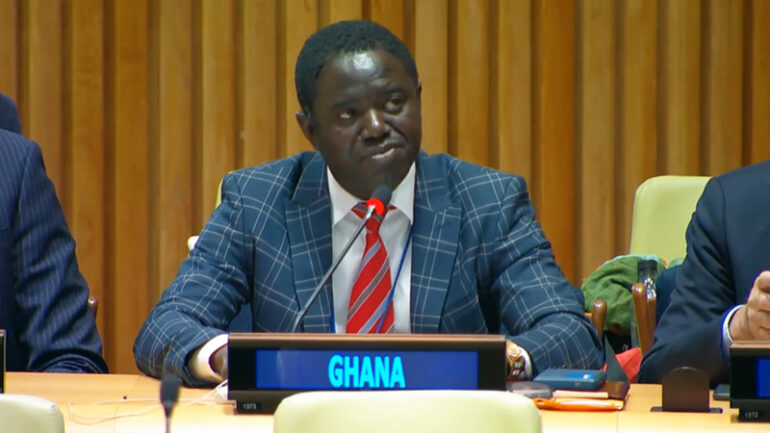

- Posted by admin
- Posted in Statement & Remarks, Third Committee
Dr. Simon Adu
Nuclear Security Department
Nuclear Installation Directorate,
Ghana Nuclear Regulatory Authority
United Headquarters
May 7th, 2026, New York
AT THE 2026 CONFERENCE OF THE PARTIES TO THE TREATY ON THE NON-PROLIFERATION OF NUCLEAR WEAPONS:
Mr. Chair,
I congratulate you on your assumption of the role of Chair of Main Committee 1 (the Disarmament Pillar) of the 11th Review Conference of the Nuclear Non-Proliferation Treaty. You have our full support and cooperation in guiding our work. Ghana aligns itself with the statements delivered by the African Group and the Non-Aligned Movement and reaffirms its commitment to the full and balanced implementation of the Treaty on the Non-Proliferation of Nuclear Weapons. My delegation would like to make the following statement in our national capacity. Nuclear disarmament remains a key priority of the Treaty and the central test of its credibility. The NPT cannot endure as a sustainable bargain if obligations on non-proliferation are rigorously enforced while disarmament commitments under Article VI remain indefinitely deferred.
At a time of growing geopolitical tension, nuclear arsenals are being modernized, strategic trust is diminishing, and longstanding arms control arrangements continue to erode without credible replacements. Dangerous rhetoric regarding the possible use of nuclear weapons has re-emerged, increasing the risk of miscalculation and undermining international peace and security. For non-nuclear-weapon States, this continued imbalance threatens confidence in the Treaty itself. The indefinite extension of the NPT in 1995 was accompanied by clear political commitments towards disarmament. Those commitments, reaffirmed in 2000 and 2010, remain valid and must be fully implemented.
Ghana therefore wishes to underscore three urgent priorities.
First, nuclear-weapon States must reaffirm their unequivocal undertaking to eliminate their nuclear arsenals and translate that commitment into concrete, measurable, time-bound and verifiable action. Transparency and accountability are indispensable. There must be regular structured reporting on progress under Article VI, including information on arsenals, delivery systems, fissile material for military purposes, and efforts to reduce the role of nuclear weapons in security doctrines.
Second, pending total elimination, urgent measures are needed to reduce nuclear dangers. Ghana reiterates the call for a universal, unconditional, legally binding and non-discriminatory
instrument on negative security assurances for all non-nuclear-weapon States against the use or threat of use of nuclear weapons under any circumstances. We also urge nuclear-weapon States to adopt no-first-use policies as an important interim step. Such measures help reduce immediate risks, but they cannot substitute for the complete elimination of nuclear weapons.
We remain concerned by continued reliance on extended nuclear deterrence and nuclear sharing arrangements, which preserve the legitimacy of nuclear weapons and run contrary to the letter and spirit of the Treaty. Durable security cannot be built on permanent nuclear dependence. Third, the global norm against nuclear testing must be preserved and strengthened. On the thirtieth anniversary of the Comprehensive Nuclear-Test-Ban Treaty, Ghana calls for its universalization and early entry into force. Any return to nuclear testing would constitute a grave setback for international peace and security and for the multilateral disarmament framework.
The use or threat of use of nuclear weapons remains fundamentally inconsistent with the purposes and principles of the Charter of the United Nations and international humanitarian law. Their total elimination remains the only absolute guarantee against their use. The NPT remains the cornerstone of the global nuclear disarmament and non-proliferation regime. Its continued legitimacy depends on balanced implementation of all three pillars and renewed political will, particularly by nuclear-weapon States, to fulfil their obligations in good faith.
In conclusion, Mr. Chair, Ghana calls on all States Parties to use this Review Conference not merely to repeat established commitments, but to restore trust and take irreversible steps towards
the achievement of a world free of nuclear weapons.