
59th Commission on Population and Development Side Event
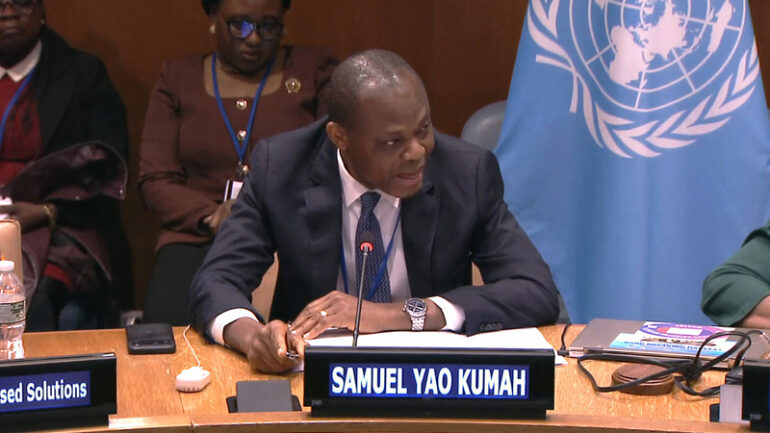

- Posted by admin
- Posted in News, Statement & Remarks
Ambassador Samuel Yao Kumah
Ghana’s Representative to the United Nations
Conference Room 8, UNHQ
April 13th, 2026, New York
STATEMENT: 59TH COMMISSION ON POPULATION AND DEVELOPMENT SIDE EVENT UNDER THE THEME, “INTEGRATING POPULATION DYNAMICS, TECHNOLOGY & RESEARCH FOR SUSTAINABLE DEVELOPMENT: ADVANCING WASH OUTCOMES”
Excellencies, Distinguished Delegates, Ladies and Gentlemen,
I am pleased to welcome you to this side event, convened on the margins of the 59th Session of the Commission on Population and Development. The focus of today’s discussion, integrating population dynamics, technology, and research to advance sustainable water, sanitation and hygiene (WASH) outcome, is both timely and highly relevant, particularly as our countries navigate the complex interplay between rapid demographic change, urbanization, and growing environmental pressures.
Let me from the outset register my deepest appreciation to H.E. Dr. Nabhit Kapur, Permanent Observer for the Pan-African Intergovernmental Agency for Water and Sanitation for Africa to the United Nations for his leadership role in forging closer partnership between the Permanent Mission of Ghana to the UN and his organization, especially in co-hosting this important event.
Across Ghana and the wider African region, demographic expansion, rapid urbanization, and mounting environmental pressures are converging in ways that place increasing strain on essential services, particularly in the area of water, sanitation and hygiene.
Ghana’s population currently stands at approximately 34.4 million and continues to grow, with the youth population projected to rise significantly by 2030. At the same time, urbanization—now at nearly 57 percent—is driving the rapid expansion of cities such as Accra, Kumasi, and Tamale. Too often, this growth outpaces infrastructure development, resulting in the proliferation of underserved and high-risk communities with limited access to safe water and sanitation.
In this context, data and evidence-based planning are indispensable. Ghana’s 2021 digital Population and Housing Census, alongside tools such as the Ghana Stats mobile application, are enabling more targeted interventions, better integration of WASH priorities into health and education systems, and improved tracking of progress toward the Sustainable Development Goals. At the same time, Ghana is actively leveraging technology and innovation to respond to these challenges.
In the WASH sector, we are seeing promising solutions, including container-based sanitation systems, digital platforms to coordinate septic services, and youth-led recycling initiatives. These innovations, supported by mobile payment systems and digital coordination tools, are enhancing efficiency, transparency, and accountability.
Beyond WASH, technology is also transforming other critical sectors, reinforcing the importance of integrated approaches to population and development. In education, for example, Ghana is deploying technology-enabled learning solutions to bridge the digital divide and expand access to quality education, particularly in rural and underserved communities. Offline platforms such as the iBox Learning Management System and complementary initiatives are ensuring continuity of learning and equitable access to educational resources, even in low-connectivity environments.
Similarly, in the health sector, digital innovations are strengthening maternal healthcare delivery. Platforms such as DHIMS2 and the e-Tracker are improving real-time data capture, monitoring pregnancies, and enhancing continuity of care. Telemedicine and digitally enabled referral systems are further supporting frontline health workers, particularly in remote areas, to provide timely and life-saving interventions.
These experiences underscore a central lesson: that the integration of population data, technology, and sectoral policies is essential for delivering sustainable and inclusive development outcomes.
Ghana’s commitment to this integrated approach is rooted in its long-standing engagement with the International Conference on Population and Development Programme of Action. Since the Cairo Conference, under the distinguished leadership of Professor F. T. Sai, Ghana has remained a strong advocate for advancing population and development priorities, including reproductive health, gender equality, and youth empowerment.
While we have made notable progress, we are equally mindful of the challenges that remain. Achieving the objectives of the ICPD Programme of Action requires a comprehensive, cross-sectoral approach. For instance, maternal health outcomes are closely linked to WASH conditions, highlighting the need for stronger interlinkages across sectors.
Emerging technologies, including artificial intelligence, offer significant opportunities to strengthen these linkages—enhancing data collection, analysis, and service delivery, and enabling more responsive and targeted interventions.
However, technology alone is not sufficient. Effective partnerships and coordinated action across governments, the private sector, research institutions, and communities are essential to ensure that innovations translate into tangible and equitable outcomes.
In this regard, Ghana remains firmly committed to the Sustainable Development Goals and to advancing collaborative, inclusive, and evidence-based solutions. We also recognize and appreciate the support of international partners and the contributions of the diaspora in advancing innovation and capacity-building.
Excellencies, Ladies and Gentlemen,
This side event provides a valuable platform to share experiences, exchange knowledge, and strengthen partnerships. I trust that the exchanges this afternoon will be instrumental in advancing our collective efforts to integrate population dynamics, technology, and research in ways that deliver sustainable, resilient, and inclusive WASH outcomes.
Let us leave this gathering not only with new ideas, but with renewed partnerships, clear pathways, and a shared sense of purpose.
I thank you.