
2026 ECOSOC Forum on Financing for Development Follow-Up (FfD Forum)
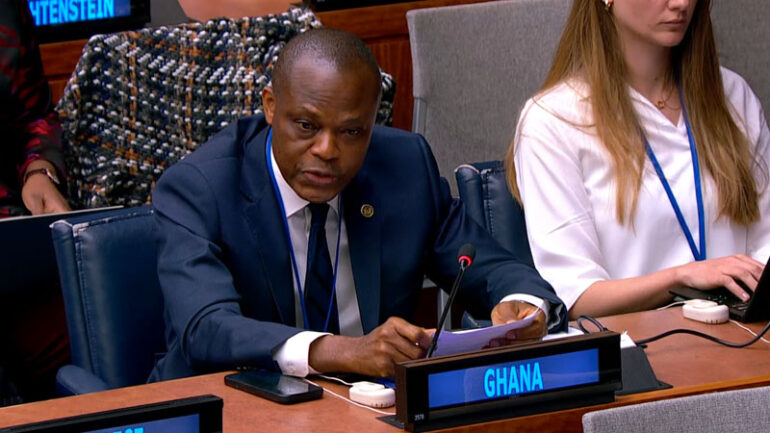

- Posted by admin
- Posted in News, Statement & Remarks
Ambassador Samuel Yao Kumah
Ghana’s Representative to the United Nations
Conference Room 4, UNHQ
April 23th, 2026, New York
GENERAL DEBATE OF THE 2026 ECOSOC FORUM ON FINANCING FOR DEVELOPMENT FOLLOW-UP
Mr. President,
Excellencies,
Ghana aligns itself with the statements delivered by the G77 and China, and the Africa Group, and wishes to make the following additional remarks in its national capacity.
The global financing landscape remains deeply strained, particularly for developing countries. During Ghana’s domestic debt restructuring, pensions earned over a lifetime had to be reduced. A question emerged: “When the world’s finances go wrong, why is it always the poor who pay?” This question is at the heart of our discourse, and must guide our work.
We meet at a defining moment for our shared agenda following the adoption of the Sevilla Commitment, to which Ghana remains firmly committed. Official development assistance fell by 23.1 per cent in 2025—the largest annual contraction on record. Borrowing costs remain elevated, while trade is fragmenting. The US$4 trillion annual SDG financing gap will not close on its own. It will require decisive action—and, above all, trust.
Ghana speaks today as a country that has lived the hard edge of this crisis and is now emerging, through deliberate reform. We have strengthened our fiscal framework, introduced a primary surplus rule, and set a clear debt ceiling, alongside key oversight institutions. Inflation has declined sharply, growth has rebounded, and we are on the verge of exiting our IMF-supported programme this year.
Excellencies, on the areas under review, let me highlight four brief priorities:
First, Ghana calls for scaled-up local currency financing and truly country-owned blended finance, to unlock capital for SMEs, particularly those led by women and youth.
Second, we reaffirm the need for a rules-based trading system, full implementation of the African Continental Free Trade Area, and value addition to Africa’s critical minerals.
Next, urgent reform is needed in the international financial architecture—including quota reform, greater rechanneling of Special Drawing Rights, and fair timely debt treatment across all creditors.
Fourth, Ghana underscores the importance of strong national data systems as the foundation for accountability.
We also urge partners to reverse the decline in ODA and to honour the 0.7 per cent commitment, while advancing negotiations on a United Nations Framework Convention on International Tax Cooperation.
Excellencies, the test of this Forum will not be the elegance of our language, but the honesty of our follow-through, and whether we can offer a better answer to the question: why is it always the poor who pay when the world’s finances go wrong?
I thank you.