
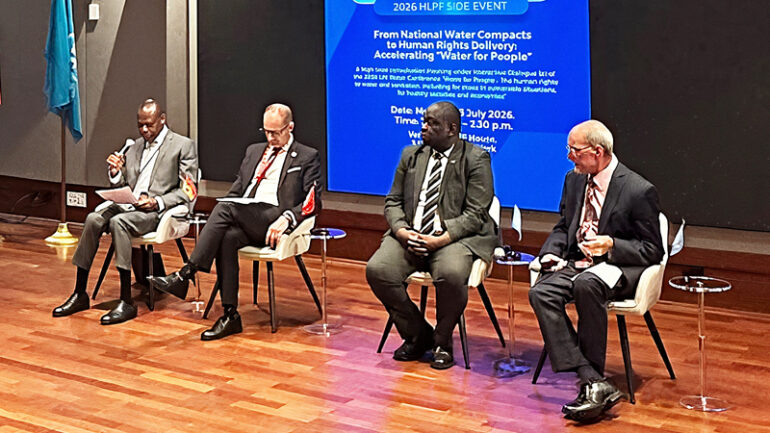
From National Water Compacts to Human Rights Delivery – Accelerating “Water for People

Ambassador Samuel Yao Kumah
Ghana’s Representative to the United Nations
13th July 2026 UNHQ
UNICEF House, New York
HIGH-LEVEL SIDE EVENT: CO-CONVENED BY GHANA AND SWITZERLAND
UNDER THE THEME From National Water Compacts to Human Rights Delivery – Accelerating “Water for People
Excellencies, Distinguished Partners, Ladies and Gentlemen,
It is an honour to welcome you to this important side event, which Ghana is pleased to co-convene with Switzerland. I thank UNICEF for hosting us and acknowledge the leadership of UN-Water as we prepare for the 2026 United Nations Water Conference.
The 2023 United Nations Water Conference generated important momentum. The 2026 Conference in Abu Dhabi, particularly Interactive Dialogue (a) on “Water for People”, must now translate that momentum into tangible progress towards the realisation of the human rights to safe drinking water and sanitation, especially for those furthest behind.
Ghana has taken concrete action through its Presidential Compact on Water, Sanitation and Hygiene. The Compact provides a whole-of-government framework for translating political commitment into equitable service delivery, stronger institutions and measurable results for vulnerable and underserved communities.
Against this background, Ghana strongly supports the proposed Global Acceleration Platform for National Water Compacts. As a country-driven mechanism responsive to national priorities, it can help countries translate political commitments into practical, financed and measurable action.
In this regard, Ghana wishes to highlight four considerations that should guide the Platform’s development.
First, delivering for people through equity and human rights. National Water Compacts must deliberately prioritise those furthest behind, particularly women and girls, persons with disabilities and climate-vulnerable communities. By strengthening pro-poor approaches, gender-responsive planning and social accountability, we can translate the human rights to water and sanitation from international commitments into lived realities.
Second, financing for equity and sustainability.
Political commitment must be supported by credible and adequately costed plans, as well as financing arrangements that reach underserved communities. The Platform can assist countries to develop investable pipelines combining public resources, affordable and equitable tariff systems, climate finance and responsible private capital, while safeguarding equity and long-term sustainability.
Third, partnerships, coherence and country leadership. Country ownership is indispensable. National Water Compacts must be government-led, anchored in national development priorities and supported by effective coordination across ministries, local authorities and communities.
Development partners, financiers and technical institutions should align behind these nationally owned plans, reduce fragmentation and support implementation through predictable financing, practical technical assistance and shared accountability for results.
Fourth, scaling impact and sustaining momentum.
The Platform should serve as a catalyst by connecting countries for peer exchange, matching national needs with appropriate technical and financial support, and feeding practical lessons into the outcomes of the 2026 Conference. In this way, it can help sustain political momentum and accelerate people-centred results.
Excellencies,
The human rights to water and sanitation will be realised only when every person, especially the most vulnerable, has safe, affordable and reliable access. Ghana stands ready to work with Switzerland, UNICEF, WHO, UN-Water and all partners to shape and champion the proposed Global Acceleration Platform. Our shared objective must be to ensure that the 2026 United Nations Water Conference produces ambitious and actionable commitments under the “Water for People” banner.
Let us move from pledges to pipelines, and from policy to people.
I thank you and look forward to a fruitful exchange.