
High-Level Session at 59th session of the Commission on Population and Development,

- Posted by admin
- Posted in News, Statement & Remarks
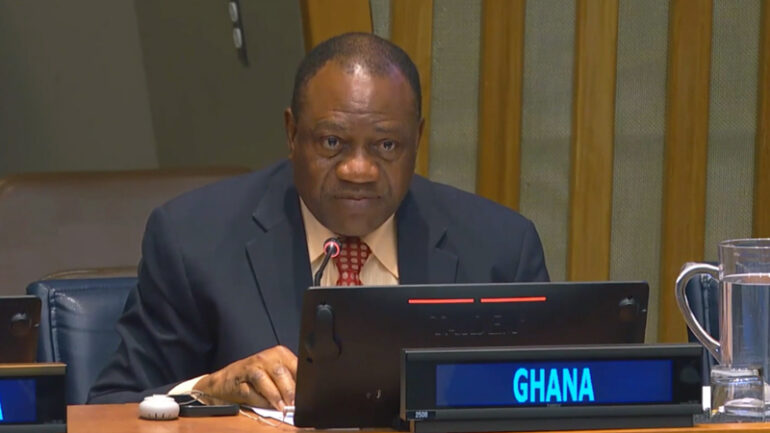
Hon. Abdul-Rashid Hassan, Pelpuo
Minister for Employment and Labour Relations
April 13th, 2026, New York
UNFPA SIGNATURE SIDE EVENT – CPD59 “THE INFRASTRUCTURE OF SURVIVAL: HARNESSING TECHNOLOGY, INNOVATION AND CATALYTIC CAPITAL TO END PREVENTABLE MATERNAL DEATHS IN AFRICA” 13 APRIL 2026 | UNITED NATIONS HEADQUARTERS, NEW YORK
Excellencies,
Distinguished Colleagues,
Honourable Ministers,
Development Partners,
Ladies and Gentlemen,
I bring you warm greetings from the Government and people of the Republic of Ghana, and from His Excellency John Dramani Mahama, The President of the Republic of Ghana.
It is an honour to participate in this important dialogue convened under the auspices of the United Nations Population Fund, during the 59th Session of the Commission on Population and Development.
The Urgency of the Moment
We meet at a critical juncture.
Despite notable progress over the past two decades, Africa still accounts for nearly 70 percent of global maternal deaths. This is not acceptable. This is not just a statistic it is a call to action. (WHO, UNICEF, UNFPA, World Bank Group & UNDESA, Trends in Maternal Mortality, 2000–2020).
Maternal mortality is not merely a health issue. It is a development challenge, a human rights concern, and fundamentally, a question of equity and justice.
No woman should lose her life while giving life especially when we possess the technical expertise, the tools, and the innovations to prevent it.
From Political Will to Political Action
As Minister for Labour, Jobs and Employment, and President of the African Parliamentary Network on Population and Development, I firmly believe that our greatest responsibility lies in translating political commitments into measurable outcomes.
Africa has demonstrated strong political will through frameworks such as:
• African Union Agenda 2063 (African Union, 2015)
• The Africa Health Strategy (2016–2030) (African Union Commission)
• Campaign on Accelerated Reduction of Maternal Mortality in Africa Plus (The CARMMA Plus initiative (African Union, 2021))
Similarly, Ghana has exuded exemplary leadership through initiatives including:
• Free maternal healthcare policy under the National Health Insurance Scheme (NHIS)
• The High-level Presidential Initiative on Maternal Health Emergency Rescue (PRIMER). A new political initiative moving maternal health to a political and cross sectoral agenda – with the formation of a multi-sectoral group to oversee PRIMER under the leadership of the Senior Presidential SDG Advisory Unit; and in partnership with UNFPA and the National Development Planning Commission (NDPC)
• Strengthened community-level care through the Community-based Health Planning and Services (CHPS) programme, bringing essential maternal and reproductive health services closer to rural and underserved populations
• Mahama Care that supplements NHIS, expands access to universal health coverage and maternal health care – supports maternal health complications such as renal failure and maternal diabetes
• Sustainable Diverse financing and Partnerships for maternal health through government funding, private sector support and donor contributions
• Free Primary Health Care that further expands health care access at lower levels
• Investments in digital health innovation – leveraging telemedicine, mobile health and data systems to improve referrals, track pregnancies, and ensure timely interventions in hard-to-reach areas.
Yet, the challenge before us is clear:
How do we convert commitments into sustained investments and tangible results?
The answer lies in ownership.
We must move decisively from donor dependency to domestic sustainable financing and resource mobilization, ensuring that our national budgets reflect our priorities especially in safeguarding maternal and newborn health.
Building Africa’s Health Sovereignty
The concept of health sovereignty is no longer aspirational, it is imperative.
Through the leadership of institutions such as the African Union Commission, Africa Centres for Disease Control and Prevention, and African Union Development Agency, Africa is charting a new course.
A course that prioritizes:
• Local manufacturing of essential medicines
• Harmonized regulatory systems
• Regional collaboration and pooled procurement mechanisms
By consolidating demand and strengthening supply chains, we can reduce costs, eliminate inefficiencies, and ensure that life-saving commodities reach even the most remote communities.
Harnessing Innovation and Technology
Distinguished colleagues,
Innovation must be at the heart of our response.
We must scale up proven, life-saving solutions such as:
• Heat-stable maternal health commodities
• Real-time inventory tracking systems
• Digital tools for demand forecasting
• Local manufacturing of maternal health medicines
• Use of Drone to strengthen delivery of maternal lifesaving medicines and blood
Technology enables us to bridge the last-mile gap, ensuring that no facility runs out of critical supplies and no woman is left behind.
However, innovation without access is meaningless.
We must ensure affordability, scalability, and sustainability.
Financing the Future: Catalytic Capital and Partnerships
A key pathway to transformation lies in innovative financing mechanisms.
• The co-financing and matched-funding approach supported by the United Nations Population Fund demonstrates what is possible when governments and partners act together.
• For every dollar invested by governments, additional resources are mobilized doubling impact and accelerating access.
• In this regard, Ghana may qualify for matched funds for family planning over the last three years.
This is the kind of catalytic capital we must scale across the continent.
We call on:
• Governments to increase domestic health financing
• Development partners to align with African-led priorities
• The private sector to invest in scalable health solutions
The Role of Parliamentarians
As President of the African Parliamentary Network on Population and Development, I wish to emphasize the crucial role of parliamentarians.
We are not only lawmakers, we are custodians of accountability.
Our role is to:
• Advocate for increased budget allocations, release and expenditures
• Strengthen legislative frameworks
• Ensure oversight of implementation
• Champion policies that protect women and families
Parliamentary leadership will be essential in sustaining momentum and ensuring that commitments are honoured.
A Call to Collective Action
Excellencies,
The path to ending preventable maternal deaths in Africa is clear.
What is required now is collective resolve.
Let us commit to:
• Strengthening regional cooperation
• Investing in resilient health systems
• Scaling innovations that save lives
• Ensuring that no woman pays the price of systemic failure
Conclusion
In closing, let us remember:
Every maternal death is preventable.
Every life lost is one too many.
Africa has the leadership, the technical expertise, and the partnerships required to change this narrative.
Let us act boldly, decisively, and collectively to build a future where maternal survival is guaranteed, not uncertain.
No woman in Africa should die while giving life.
I thank you.