High-Level Policy Dialogue Of The Africa Dialogue Series 2026

- Posted by admin
- Posted in News, Statement & Remarks
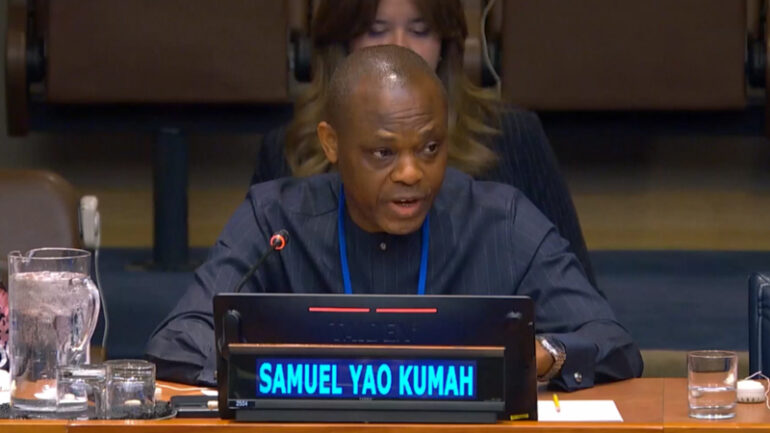
Ambassador Samuel Yao Kumah
Ghana’s Representative to the United Nations
Conference Room 4, UNHQ
May 29th, 2026, New York
SETTING-THE-STAGE REMARKS: HIGH-LEVEL POLICY DIALOGUE OF THE AFRICA DIALOGUE SERIES 2026
Excellencies,
Distinguished Participants,
Ladies and Gentlemen,
I am pleased to join you for this High-Level Policy Dialogue of the 2026 Africa Dialogue Series. I wish to commend the Office of the Special Adviser on Africa, the Permanent Observer Mission of the African Union to the United Nations, and all partners for convening this important platform for reflection, exchange, and collective action.
The Africa Dialogue Series has, over the years, become a valuable platform for bringing Africa’s priorities to the centre of global dialogue. Last year, it helped amplify the call for reparatory justice for Africans and people of African descent a call which gained further momentum this year through a historic General Assembly resolution recognising the gravity of the transatlantic slave trade in enslaved Africans.
This year, the Series turns to Water and Sanitation for Life, with a focus on harnessing water resources for the Africa we want. It invites us to consider how water can be better managed, financed, and protected as a foundation for public health, resilience, economic transformation, and sustainable development.
As we begin our deliberations, it is important to recognize that water and sanitation must no longer be viewed only as basic social services. They are strategic assets and core economic infrastructure, directly linked to public health, food security, agriculture, energy generation, industrialization, sustainable urbanization, peace, and climate resilience.
This perspective is especially important as Africa’s cities continue to grow rapidly, bringing increased demand for housing, jobs, services, and resilient infrastructure. Water and sanitation sit at the centre of that equation. Without adequate planning and investment in these systems, cities face greater risks of inequality, disease, environmental stress, and slower economic growth. When water and sanitation systems are resilient and inclusive, they can support healthier communities, more sustainable urban growth, and stronger local economies.
The Africa Water Vision 2063 and Policy speaks directly to this broader understanding. It frames water not simply as a natural resource, but as a strategic asset for transformation one that can support climate resilience, foster economically vibrant cities, enhance food and energy security, and secure long-term prosperity.
This continental perspective also resonates strongly with Ghana’s own development priorities. With an estimated average urban growth rate of 4.2 per cent and an urban population projected to reach 65 per cent by 2030, Ghana’s rapid urbanization makes sound water and sanitation management essential to economic transformation, sustainable urban development, and improved quality of life. In this context, Ghana’s 2024 Presidential Compact on Water, Sanitation and Hygiene, with the United Nations, reflects a strong commitment to expanding access to WASH services and accelerating progress towards SDG 6.
As we engage today, this framework should help guide our focus towards practical and forward-looking recommendations that strengthen partnerships, mobilize catalytic financing, promote innovation, and integrate water and sanitation priorities more fully into national, regional, and global development processes.
The African Union’s designation of 2026 as the Year of Water and Sanitation gives us an important opportunity to translate vision into action. Let us use this Dialogue to strengthen our collective resolve to place water and sanitation at the centre of Africa’s development, and to build water-secure, climate-resilient, and inclusive communities across the continent.
I thank you.