
Second Committee, 4th plenary meeting – United Nations General Assembly
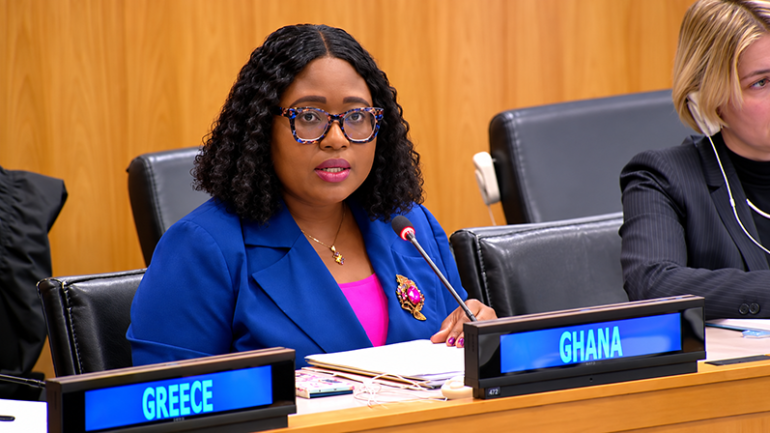

- Posted by admin
- Posted in News, Second Committee
Miriam Aba Arhin
Miniter-Counsellor and Second Committee Expert
5th to 6th October 2026
Conference Room 2
UNHQ New York
GENERAL DEBATE OF THE SECOND COMMITTEE AT THE 81ST SESSION ON THE THEME: FINANCING SUSTAINABLE DEVELOPMENT IN A CHANGING GLOBAL ECONOMY TO ACCELERATE SDG IMPLEMENTATION
Madam Chair,
Excellencies,
Distinguished Delegates,
Ghana aligns itself with the statements delivered on behalf of the Group of 77 and China and the African Group. We congratulate you and assure the Bureau of our full cooperation.
At the heart of our deliberations is a critical question: how to mobilise the financing needed to translate our sustainable development ambitions into tangible results. Mounting debt pressures, constrained fiscal space and persistent financing gaps are limiting the capacity of developing countries to invest in their development priorities. With 2030 approaching, the challenge before us is clear: to ensure that our ambitions are matched by adequate and accessible means of implementation, and that our commitments translate into concrete outcomes.
FINANCING FOR DEVELOPMENT: CLOSING THE IMPLEMENTATION GAP
Access to affordable financing remains a major constraint. The external debt of developing countries reached an estimated US$12.3 trillion in 2025, while in sub-Saharan Africa, public external debt service absorbs almost 16 per cent of government revenue. Ghana therefore calls for accelerated implementation of the Sevilla Commitment through affordable long-term and concessional financing, effective debt solutions, and a more inclusive international financial architecture. Greater voice for developing countries and fairer, more transparent sovereign credit-rating methodologies are also essential to addressing Africa’s high cost of capital. FINANCING TRANSFORMATION:
FROM EXTRACTION TO VALUE ADDITION
Affordable financing must support long-term economic transformation by building productive capacity, promoting diversification and creating decent jobs. For Africa, this means a paradigm shift from raw material exports to domestic processing and beneficiation, supported by stronger regional value chains and the African Continental Free Trade Area. Ghana maintains that Africa must strengthen its industrial capacity to process more of its resources at home, retain greater value and advance greater agency and selfreliance.
DOMESTIC RESOURCE MOBILISATION: SAFEGUARDING DEVELOPMENT RESOURCES
At the same time, developing countries must strengthen their capacity to mobilise and retain the resources needed to finance their development. Illicit financial flows undermine these efforts by draining domestic resources and constraining fiscal space. Ghana is among the countries applying internationally agreed methodologies to measure these flows, helping to strengthen the evidence needed to identify and curb resource leakages. Ghana, therefore, calls for a stronger international cooperation to combat illicit financial flows and strengthen asset recovery and return.
CLIMATE FINANCE: BUILDING RESILIENCE WITHOUT DEEPENING DEBT
Financing is equally critical to building climate resilience. Africa contributes less than four per cent of global greenhouse gas emissions, yet continues to bear severe climate impacts. For countries already facing high debt burdens, climate vulnerability must not become another pathway into indebtedness. Ghana therefore reiterates the need for predictable and accessible climate finance, with greater provision of grants and concessional resources for adaptation and resilience.
PEOPLE-CENTRED DEVELOPMENT
The purpose of mobilising finance, strengthening productive capacity and building resilience must ultimately be to improve people’s lives. Development must deliver poverty reduction, decent jobs, stronger social protection, and quality health and education. Economic growth must have a human face, with its benefits felt in the lives and livelihoods of our people.
Madam Chair,
THE ROAD TO THE 2027 SDG SUMMIT: FROM COMMITMENTS TO DELIVERY
It is with this focus on implementation and impact that we must approach the 2027 SDG Summit. The Summit must provide renewed impetus for accelerating progress towards the Sustainable Development Goals in the remaining years to 2030. Its success will depend not on the multiplication of commitments, but on our collective ability to provide the means to implement those already made.
It is by translating commitments into action and action into concrete outcomes that we can restore trust in multilateralism and advance the promise of the 2030 Agenda.
I thank you